Tuesday, September 11, 2012

Dumb Luck

9/10/12: Here we are back in Maine.  And, right away we have one of our run-ins with dumb luck.  Our first night back we need a motel while we are having one of the trailer legs straightened (it is not wise to drive
7 Mountains Motel, Rockport, Maine - our room at far left
away pulling the tiny tent trailer without the legs retracted).  Always looking for a bargain, we try a motel in Rockport that we had noticed was closed earlier in the summer, until we saw it being shown by a realtor one day and open for business the next.

Rockport Harbor
After a night there, we are offered a deal we can't refuse - a month's stay at $200 less than it costs us at our old camp spot on the cove in Lobster Buoy Campsites.  Not only that, but there is an indoor bathroom for mid-night needs, not a portable outhouse to trek to in the dark, AND a refrigerator, microwave, TV, air conditioning, and heat.  Did I mention that Rockport is home to a stunning small harbor, beautiful old homes, great places to walk, and is right next to Rockland, where the boat is?

Conrad seems to be feeling better and is back at work on the boat.  He is focusing on the electrical system right now, and our new goal is to get the boat ready this year, keep having fun in Maine, and launch the boat next spring.  And, while we were in California for Katherine's wedding, the Rockland Democratic Headquarters moved to within a few blocks of the boatyard, giving me lots of nearby volunteer work to pursue while Conrad works.

For fun, on my birthday we drive on back country roads through rolling hills smothered in trees, by little lakes, cat tail-edged ponds, and villages with quaint old white wooden, steepled churches.

At Sheepscot (love these Maine names), we arrive at the Wiscasset, Waterville and Farmington Railway to ride a narrow-gauge train pulled by an original small steam engine dating from 1904.

The WW&F was the last of five narrow-gauge rail systems built in Maine, hauling freight and passengers from 1895 until closing down in 1933. 
66th birthday - OMG!
In 1985, a local man began fulfilling his childhood dream to rebuild the WW&F.  First purchasing what remained of the railroad's right of way and building an engine house, Harry Percival called on a growing group of volunteers who learned how to lay track and rebuilt five miles of rail line.  Now they're working on another mile of the old 58-mile run from the deep-water river port of Wiscasset, and have replicated the original station house, freight house, and water tank, with a car shed, turntable and other projects still in the works.

The ride is full of billowing clouds of steam and smoke, the smell of burning coal, and the blowing engine whistle.  The little steam engine chugs up steep grades through forest land and by a stream, complete with a beaver dam and the sighting of the beaver himself.  Great birthday fun!

President Obama speaks in Portsmouth, N.H.
Meanwhile, no doubt like most of you, we have been following the Republican and Democratic conventions with interest.  My daughter, Liz, is behind the scenes at the Democrats' convention in Charlotte, fact checking the 130 speeches with some of her research team from the Obama Re-election Campaign, and we are hoping to catch a glimpse of her on TV.  We don't.  But, on Maine TV we learn that the President will be coming to Portsmouth, New Hampshire for an outdoor event the day after the convention.

We manage to get tickets and join thousands waiting  for the Obamas and Bidens to arrive on September 7th..  Even Conrad is excited!  The
Me with POTUS in background
sun is out and after standing in it for over four hours, I am very happy that I am in Portsmouth, New Hampshire's 70-degree weather and not in California's Central Valley heat.

I end up standing right in front of the stage and podium where I hear both Joe Biden and Barack Obama speak.  It is simply amazing to be so close to the President and Vice-President of the United States!  Michelle Obama and Jill Biden are there.  I just can't believe that I am too!!! 
The over-the-top moment for me is when all of them leave the platform after the speeches and start walking along the line of people close to the stage to speak to and shake hands with us.  I actually touch and talk to the President of the United States!  And then Michele, Vice President Biden and Jill Biden.  I am beyond excited.

I was born in Portsmouth, New Hampshire when my father was stationed at the Portsmouth Naval Shipyard after World War II ended.  Now this location will have even more meaning for me.  How I wish my mother and father were still alive and here to experience this day.

Wednesday, August 29, 2012

True Love Trumps the Camden Opera House

7/29/12: I had hoped to add a new posting about the Camden Opera House before we returned to California at the end of July for the joyous wedding of my daughter, Katherine, and her fiancee, Kemble Pope.  But you know what happens to the best laid plans.... 

Katherine and Kemble wed in the Woods' walnut grove in the Capay Valley, outside of Davis, California.
 Now we are back in Maine, so here goes with the delayed posting.  In June, I was lucky enough to have a private tour of the Camden Opera House while we were staying in Camden.  In July, Conrad and I went to a showing at the opera house of Forrest Gump because it featured some nearby sights, like the Marshall Point Lighthouse, and a number of locals as film extras.  Since then I've meant to write about the opera house.
Grand staircase to the Camden Opera House

The opera house is a charming Victorian-era theater, still much used by the Camden community.  When it  was built in 1894, it was the tallest building in the county with its three brick stories.  The opera building's auditorium is on the second and third floors, with various municipal offices on the first floor.

For the Forrest Gump performance, we climbed the grand staircase from the street up to the halls of the opera house.  The auditorium and entry are hung with grand chandeliers, and the opera hall boasts a horseshoe balcony, antique moldings, detailed restorations of Victorian friezes, and beautifully replicated gilt stenciling.
 
The Camden Opera House stage
The interior was originally decorated by Willis Carleton, a lifelong resident of nearby Rockport who painted stage scenery in New York as a career.  In 1993, a hundred-year renovation of the opera house replicated Carleton's stereo relief decoration in gold and white on the stage's arch, balcony front, and loge boxes.  The auditorium itself is 36 feet by 33 feet and was originally constructed complete with a set of scenery and opera chairs.  There was a kitchen, ticket office and checkroom to the left of the main landing; and on the right were individual rooms.  Today, the layout is almost the same.
View of opera house balcony and orchestra seating
 
Opening night, June 6, 1894, featured the Boston Opera Company's performance of "Maritama", followed by a grand ball with music by the company orchestra.  Shortly after that, the opera hall was booked by the Justin Adams Co., with scenery arriving from Boston.  The local Vinalhaven fire station rented the space next for a demonstration drill and a Firemen's Ball.
 
In the early 1900's, with the advent of movies, three short movies were shown at the opera house on Saturday evenings followed by dancing to the tunes of an orchestra playing from the orchestra pit. Traveling shows continued to perform at the opera house, including the sensational (at the time) 1908 melodrama "How Women Ruin Men."  Later, in 1919, Gladys Kirk and her entourage appeared for one night only; the advertisement for their show reading "there is nothing left to the imagination."  If they had only known what the world would be like today!

Boxes at the opera house
Firemen's Balls continued to draw large crowds each year.  And, in the 1930's and 1940's the opera house hosted many big bands as locals danced the foxtrot, waltz, and later, the Lindy.  Community groups performed in minstrel shows, and local schools staged plays, speaking contests, and graduations at the opera house.  Traveling shows included appearances by Mae West, Tallulah Bankhead, Lillian Gish, and other famous performers of the day.

When Kerry Hadley, the manager of the opera house, gave me my tour, she showed me a refurbished room dedicated to Katharine "Kay" Aldridge Tucker, a legendary magazine model and star of many popular 1940's matinee serials, who later became a well-loved Camden resident.

As a thank you for the tour, I wrote a brochure for visitors to the Katharine Aldridge Tucker Room about Kay's life.  Her's is a fun and truly American story of a mischievous girl raised in genteel
Kay Aldridge as a Camden hostess

poverty who didn't know that there was such a thing as a model and had seen only a few movies before suddenly rocketing to fame as one of the world's top photographic models, and then pursuing a Hollywood film career.  

Last night there was a performance by the Maine Pro Musica Orchestra at the Camden Opera House with refreshments in the Katharine Aldridge Tucker Room at intermission.  I was invited as a guest and my brochure was distributed for the first time.  How fun is that?

Monday, July 16, 2012

Tenting Again

Intrepid Tracker and tiny tent trailer at Lobster Buoy Campsites
7/14/12: After luxurious living for the month of June in our rented Camden house, we are quite happily back to basics in our tiny tent trailer.  We hope that July brings good weather, but right away two afternoons of grumbling, rumbling thunderstorms, stunning sheet lightning, and torrents of rain put our fifty year-old old tent to the test.

Hallelujah - the rain rolls right off!  The first week it rains often in the night and often in the day, testing the tent, and making boat work impossible.  We are cozy in our canvas cave: reading, talking, listening to the Sacramento/Stockton NPR station on our smart phone.

As for our campground, it is a very special spot - the Lobster Buoy Campsites in South Thomaston, Maine with just forty sites.  The land has been in the same family since 1916, when it was farmed by Eleanor's (the current owner's) grandparents.  Their little “camp” (house) that they built the year they were married and given the land is still here at the top of the low hill that runs down to the cove, although a bathroom has long since been added to replace the "backhouse" (outhouse).  One of Eleanor's daughters lives in the little house now; the other daughter lives on a Maine island, population: 8 families.

Eleanor's mother, Mabel, lived on this property her entire life and died here at eighty-eight after a full day's work here on a tractor and riding lawn mower.  Sometime during Mabel and her husband's (Fred's) lifetime, they opened the campground, and it is now Eleanor's..

Island with house and horses.
The place is full of character and characters. Eleanor is an energetic, seeming seventy-something hippie with a blue bandana headband worn around her forehead and her shoulder-length, graying hair. Her partner, Doug, with his long hair, old-style prosthetic left arm, and taciturn manner, looks like someone she met during the summer of love. We keep discovering campers (who are now in trailers or RV's) who have been coming every summer for thirty or forty years and whose children and grandchildren now come.  And, they all have tales to tell around the campfire about Mabel and Fred, and the campground in years gone by.  The small bathhouse, with two showers each for the men and women, is old and funky but clean, with lots of hot water for the two quarters you put in the coin slots. There are still some of the apple trees from Fred's orchard, and at each campsite, a weathered wooden picnic table, and a rusted truck tire rim as a firepit.

Lobster Buoy Campsites cove and island with Osprey nest.
The cove is home to clams and lobster pots, and boats from dinghies to kayaks to motor boats to lobster boats.  There are at least nine small islands off the cove.  On one there is a visible house, and the family who owns it brings in horses to ride every summer.  Another island has a skeletal evergreen tree topped with an osprey's nest.  The legend is of a man who invested all of his life savings to purchase the island and started building a house on the ocean side until environmentalists won a lawsuit that stopped the development to protect the osprey.

At last, it does seem like Conrad's health is improving slowly. His neck and back are still a problem, but better.  He's off to the chiropracter again this morning.  He's decreased his blood pressure medication to a point where the dizziness has lessened (it's not gone entirely) and his blood pressure is still low.  No matter the boat work delay, we're having fun and eating lots and lots of lobster.
Conrad waiting for lobster.
Lobster prices are so low that some lobstermen aren't even going out because the cost of fuel and bait exceeds the price they get for their catch.  We are diligently doing our part to raise that price by eating lobster almost daily, and exploring local spots on the water where the lobster boats dock.  It seems as if every back road in the direction of the Atlantic leads to another lovely, granite-rocked cove, edged with evergreen forest.  We've eaten at simple lobster diners with picnic tables on docks, at a high quality restaurant with a large menu, and our favorite, a place where you bring everything you need to eat and drink except the lobster, which they cook for you on the spot and bring to your picnic table.
 
Miller Lobster Company - "diner on the dock."


Friday, July 6, 2012

Lighthouses and Lightheaded

6/30/12: This June was one of the rainiest Junes in the history of Maine. So, of course, it poured on June 23rd, the first day of the Midcoast Maine Lighthouse Challenge, which was offering free admission to seven area lighthouses.  The next day was clear and I went to two lighthouses.  Both of the lighthouses I visited were quite small. Each had a home for the lightkeeper to live in, but the actual lighthouse was a small building at the end of a walkway some distance from the home.
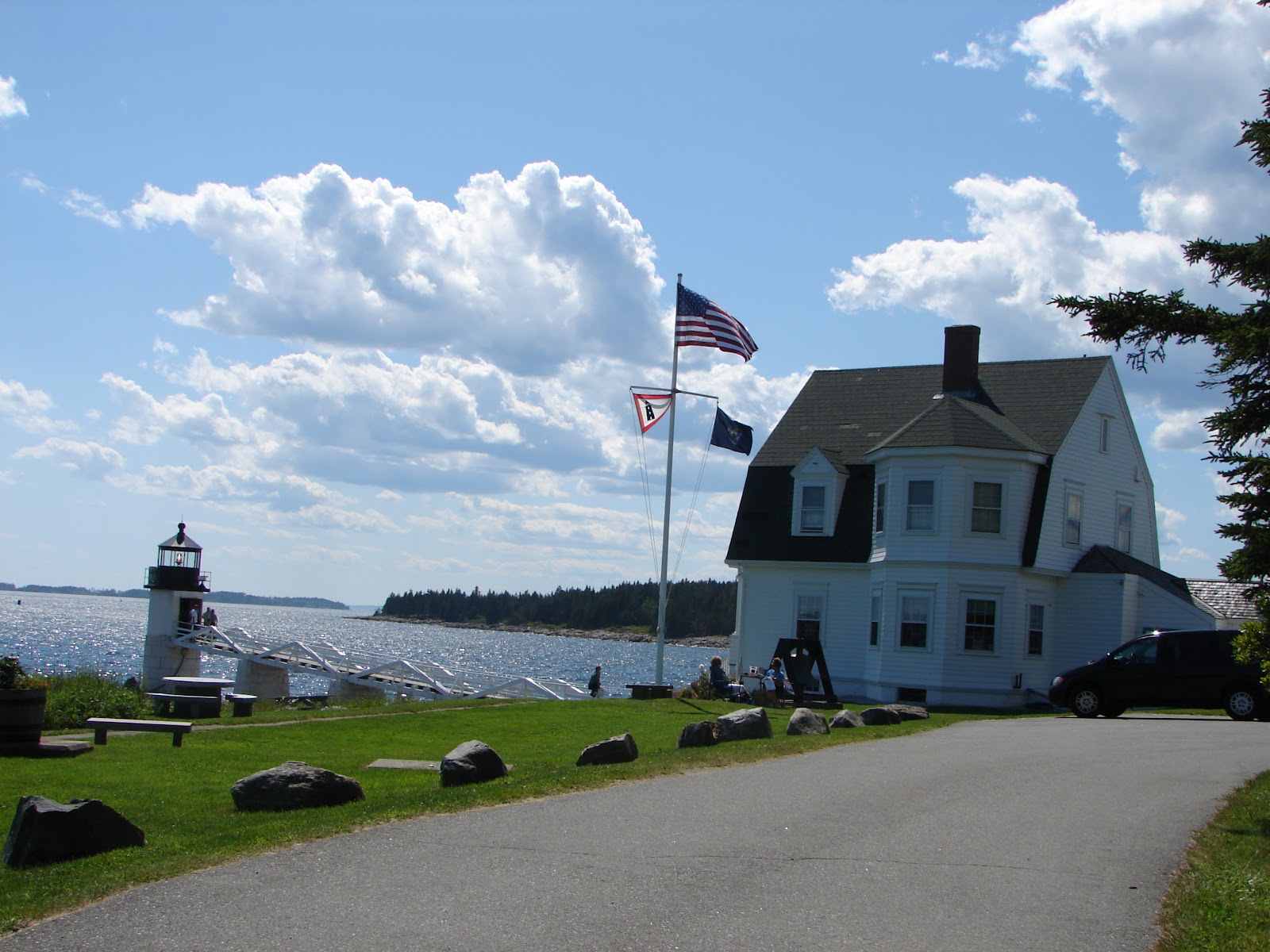
Marshall Point Lighthouse at the end of a long, wooden ramp, and the Keeper's House
The Marshall Point Lighthouse is at the end of a long wooden ramp, which begins just steps away from the lightkeeper's house. If you've seen “Forrest Gump,” you've seen the lighthouse - it's where Forrest ends the eastern segment of his cross-country run.

Marshall Point Lightkeeper's House
The original Marshall Point Lighthouse was built in 1858 and had seven lard (oink, oink) oil lamps serving as the light.  Now it's all automated and electric – boring.  In the late 1800's, there was also a bell tower with a bronze bell weighing over a thousand pounds.  Inside the tower was a weight mechanism, somewhat like the one in a grandfather clock, and a hammer that went through the tower wall.  When it was foggy the lightkeeper wound the mechanism, just like he would for a grandfather clock.  One winding lasted 4½ hours with the hammer striking the bell every 20 seconds.  Now that's replaced by a boring automated foghorn. 


The original 1832 lightkeeper's house had one and a half foot thick, stone walls.  Lightning destroyed the house in 1893 – that must have been one huge thunder and lightning show!  The current two-story, white clapboard, Colonial Revival house replaced the stone one.  It must have a lightning rod on it....
The keeper's house contains a museum with lighthouse and lobstering memorabilia, including a large collection of lobster buoys.  It is amazing how many unique markings the lobstermen have come up with to paint the buoys that mark where their lobster pots lie on the ocean floor.- each lobsterman (there aren't very many lobsterwomen) has his own design and color scheme. 

An old stone quarry
Near the lighthouse there are a number of quarries that used to ship stone by sea to many places.  All the stone was cut by hand, and the museum has an exhibit of old stone cutting tools and photos of the stone cutters and the quarries.  In the days of horses and carriages, the quarries supplied most of the cobblestones for New York City.  The first ones cut and shipped were too large for the horses' hoofs, and they slipped on them and were often injured.  They tried cutting smaller cobblestones and those worked.


Fresnel lense light at Owl's Head
Next, I went to the Owl's Head Lighthouse. The lightkeeper's house there is at the base of a hill and I climbed steep stairs up the hill to the lighthouse, which sits on a cliff overlooking Rockland Harbor (where our boat is). The lighthouse was built in 1852, and still uses its original, beautiful fresnel lense.

Ships did founder at Owl's Head, and the lighthouse was necessary.  The most dramatic tale is of the “two frozen lovers” who were shipwrecked on the point during a blizzard in the 1850's.  A small schooner was anchored at a point not far from Owl's Head one stormy night, and the captain went ashore leaving the first mate, and a seaman aboard, along with the one passenger – the first mate's fiancee, Lydia. 

Around midnight, as the storm intensified, the cables holding the ship snapped and it drifted across the bay and smashed onto the rocky ledges south of Owl's Head.  The three on board huddled on the deck of the ship under blankets, and as the schooner was breaking up, the seaman managed to climb over the ice-covered rocks to shore.  He was saved by the lighthousekeeper who just happened to be driving by in a sleigh.  A dozen men were rounded up to rescue the remaining pair and managed to get aboard the remnants of the ship, only to find the two lovers frozen inside a block of ice.
Steep stairs to Owl's Head Lighthouse, which sits perched on the edge of a cliff
Leaving nothing to chance, the rescuers wrestled the block of ice to the keeper's house and started thawing it out in the kitchen.  They chipped away the ice around the two lovers and kept them in cold water, slowly raising the temperature.  As the water warmed, the rescuers were able to move and massage the limbs of the pair.  Amazingly, after two hours of exercising and massaging, Lydia showed signs of life.  And, after another hour, the first mate opened his eyes and asked where he was.  The next day both were able to eat and drink.  All three miraculously recovered, and the two frozen lovers married to live happily ever after.

Meanwhile, back at the boat, work is slowed by rain and health problems.  Conrad has been having bad back and neck problems.  Having to replace the starter on the Tracker wasn't very good for his neck.  Without the hydraulic lift that he uses in his shop at home, he had to contort his tall body to reach everything.  Three visits to a chiropracter have helped, but our bodies are not as forgiving as they once were.  Yes, the spirit is willing, but the flesh is weak.


As if that isn't enough, he is having lots of dizzy spells during which he cannot even stay standing.  Since dizziness is one of the side effects of his blood pressure medicine, he asked his doctor to prescribe a new medication, and the dizzy spells got worse!   Recently he tried cutting back on the amount of the medication while monitoring his blood pressure levels, and things seem to be improving.  But, it's raining again....


I think our three year plan of boat renovation and travel before we ship the Flussmaus to Europe is becoming a four year plan!  The boat isn't close to ready, but we are having fun and in a beautiful place.  It's hard to complain about having to be in Maine longer than expected.

Friday, June 22, 2012

Things Never Go As Expected

On Father's Day, Conrad got tools and I got lobster!
6/21/2012:  Our Camden living room is littered with shipments we've received for the boat - a compost toilet (to replace the currently installed, old marine toilet), a gimbaled cook top (because there's no cook top and this kind keeps the pots on it level when the boat isn't, and clamped on so nothing spills), tools (a Father's Day Sale scores an 18 volt drill, circular saw, sawzall, flashlight, battery charger, batteries and a tool bag for $99), marine refrigerator (to go under the steering station seat), marine batteries and battery charger, AC converter, rotary saw, and a marine band radio.  There's a six-gallon hot water heater on order, and three "foot pumps" to help conserve water (if you want water, you have to pump it, not just turn on the spigot).  If it's not here yet, it soon will be....
Rockland Breakwater Lighthouse
 On Saturday, there were lobster boat races in Rockland.  Every harbor has races in the summer between the boats of the lobster fleet moored in its harbor.  I catch a few of the races when I hike out the mile-long Rockland Breakwater across the flat-topped, giant, granite blocks of the breakwater to the historic lighthouse at its end.  It's the first Maine lighthouse I've been inside and I explore the two-story living quarters of the lighthouse keeper, and climb up to the light. 

Rockland Breakwater stretching (from mid-left side of photograph) out into the harbor
Conrad is still struggling with the masts.  The spreader ends were so corroded when the boat was taken out of the water and the masts taken down five years ago, that the ends had to be forcibly removed from the spreader.  (A spreader "spreads" the sail at its top when the top is flat instead of pointed; then you may have a smaller, triangular topsail above that.)  Conrad spends a lot of time researching on our laptop and discovers that the manufacturer of our masts and rigging no longer is in business.  He is able to find out who bought the stock in case we need another spreader, and also finds an entirely different outfit that still makes replacement ends for the spreader we have.  The new ends arrived yesterday and we
Spreader end and bar of soap
hope they will be sufficient, so we don't have to buy a new spreader, which would be even bigger bucks than new ends - $200 for these itty bitty black things, pierced by a U-bolt (a free turning short, U-shaped bolt).

The engine and transmission oil analysis is back.  Good news - no heavy metals in the oil samples, so no rebuilding of the engine or a new engine necessary (whew - that would have likely taken the rest of the summer).  Conrad's current major project is figuring out the best technique to remove the windows without stripping away the thin fiberglass around them.  Our recent Maine rain revealed that some of the windows leak now the boat isn't covered in plastic.  We were hoping to put off replacing windows until the future, but it's obvious that some of them can't wait.  So last week we took a four-hour round trip drive to see samples of marine Plexiglas, and ordered two 4' x 8' smoke gray sheets.  Tuesday we repeated the trip with our trailer to pick up the order, driving through sylvan inland countryside pocketed with small and large lakes, farms and hardwood forests, and crossing over rivers and deep inlets from the sea.
Going to get Plexiglas, we cross the Sheepscot River to Wiscasset, founded in the 1600's, with its classic church steeples.
Once he has some old windows out, Conrad will cut the Plexiglas to fit, and bolt and caulk it to the space where the old windows are.  None of these things are small tasks and our time in Maine is looking like it will be longer than we expected.

The view from our camp site at Lobster Buoy Campground
 We are out of our rental at the end of June but we've found a gorgeous, funky hideaway called the Lobster Buoy Campground to move to.  The aging hippie owner, with a blue bandanna headband tied around her shoulder-length, graying hair, has some summer campers who have been coming for over twenty years to her campground and home at the head of a cove near Owl Harbor.  The 40 camp sites all have views of the cove, and we reserve one starting July 1.  Now that the rain seems to have subsided (well, there were only a few, brief thunder showers this morning), we're hoping for a terrific time there in our tiny tent trailer.


Saturday, June 16, 2012

Camden Town

All I could see from where I stood
was three long mountains and a wood;
I turned and looked the other way,
and saw three islands in a bay.

 
Mt. Battie viewed from Camden Harbor


6/15/12:  Who knew that Edna St. Vincent Millay was from Camden, Maine.  At 20, she wrote one of her most famous poems, Renascence.  Its opening lines, at the top of the page, were inspired by the view from the top of Mt. Battie.  (The house where we are staying is at the base of Mt. Battie.)  Born in 1892 in Rockland, where our boat is, she lived with her mother and her two sisters in Camden after her parents divorced.  Although the family was of modest means, her mother exposed the girls to culture and literature.


The Whitehall Inn, where Millay first read Renascence in public
Millay first read Renascence in public at a gathering at the Whitehall Inn in Camden, and one of the wealthy guests was so taken with her talent that she offered to pay for "Vincent," as she liked to be called, to go to Vassar.  Millay accepted the offer, graduated from Vassar, became a feminist, a political activist, the author of 15 books, and at the age of 30, the first woman to win the Pulitzer Prize. 

Now the opening lines of her Renascence are quoted in every brochure and book you pick up about Camden - you can't visit without knowing she was here!


Main Street in downtown Camden
Friendly Phyllis toured me around the Camden shops
While Conrad has been working on the boat, I've received the many boat-related FedEx parcels delivered to the house, and spent some time wandering around Camden.  The small downtown area is an easy walk from where we are staying, and our land lady, Phyllis, even took me into town one day to see her shop and introduce me to a bunch of the other store owners who are her friends.  She tells me that in July and August it is difficult to walk down Camden's Main Street, above, because of the glut of summer visitors.
 
Camden is known as the town "where the mountains meet the sea."  Although the mountains are granite, they're not mountains by California standards.  They've  been around a lot longer geologically and are worn down to what we Californians think of as hills.  The Megunticook River runs through Camden, and when the area was first settled, a sawmill and gristmill were built in 1759 on the river.  Later there were woolen and paper mills.  And later still, the area became a major producer of the lime shipped around the world for use in mortar and eventually, cement.  Today the river still runs under Main Street and splashes in a wide, shallow waterfall into Camden's harbor.  
The Megunticook River flows under Main Street and into the harbor
But Camden's greatest prosperity came from the sea.  In 1792, the first shipyard opened in Camden and sailing ships were built in the town until 1920.  Along with building ships, Camden provisioned those ships, and in time sea captains from Camden sailed to all corners of the world.

Once a sea captain's home, now a B&B
 Many of the large clapboard homes built by wealthy 19th century sea captains still grace the town, and quite a few today are Bed and Breakfast Inns.

In 1892, Camden's business district burned to the ground, and many of its wooden buildings were replaced by large brick buildings (some of which you can see in the photo of Main Street), including an opera house.

After the Civil War, the railroads and Industrial Revolution gradually ended the shipping industry that once made Maine the most prosperous state in the nation.  A brief renaissance of shipbuilding occurred during WWI and WWII when a number of warships were built in Camden, and, at the same time, the mills along the Megunticook River operated around the clock to fill wartime orders.  

One of Camden's many B&B's
Summer visitors have come to Camden since the late 1800's.  In 1897, an inn, which no longer exists, was built on top of Mt. Battie.  A few years after that, the Whitehall Inn, now a Bed and Breakfast, opened in an old house built by a sea captain.  Today there are over thirty B&B's in this little town of 5,300 residents.

Camden has become a popular living place for artists, writers and retirees, as well as a summertime mecca for tourists, like us.  We're lovin' it!

 
Camden Harbor


Saturday, June 9, 2012

At Home in Camden, Maine

Looking from Inside the Main Living Area of the House Out to the Deck
6/7/12: Today I was going to start on the hull, but it is raining again (oh right, we're in Maine).  Conrad just came home for a sandwich because it started raining hard.  He is working on the masts, which are off the boat right now, to make sure everything is there, and that the lights and other stuff work.  (We'd prefer he not have to climb a mast at sea to change a light bulb,)

I'm puttering around our new temporary home, taking photographs, blogging and reading books that Phyllis has lying around for her guests: Stern Men by Elizabeth Yates, a fictional tale about a girl growing up amidst the competition between the lobstermen on two, small, fictional islands 20 miles off the Miane Coast.  The lobstermen sell their catches in Rockland, where our boat is!

Our Living-Dining Room


Porch and Rocking Chair for Reading
The sun comes out briefly and I sit on the porch in a rocking chair reading On Whale Island by Daniel Hays, a true story of his year on a real island north of here, seven miles off of Nova Scotia.  He, his wife, and 11 year-old son lived for 12 months in a 14' x 16' two-story house that he and his father built years before - no electricity, refrigeration, or running water except what the three of them create.  It is so cold there in the winter that parts of the ocean freeze into blocks of ice, and this guy goes off his Prozac in the middle of their stay!  Not my idea of fun, but a very entertaining read.
 

Our Bedroom
 

Dining-Kitchen Area


Phyllis' Garden Shed and Artist's Studio